NSW Selective High School Placement Test Guide
NSW Selective High School Placement Test Guide
Format + what to practise first (so you’re not wasting time)
In NSW alone, 15,000+ students compete for ~3,600 places. The fastest way to improve outcomes is simple: understand the format, practise the right skills first, then build speed with timed work.
(Source: Examinate homepage stats — see References)
What’s in the test (current structure)
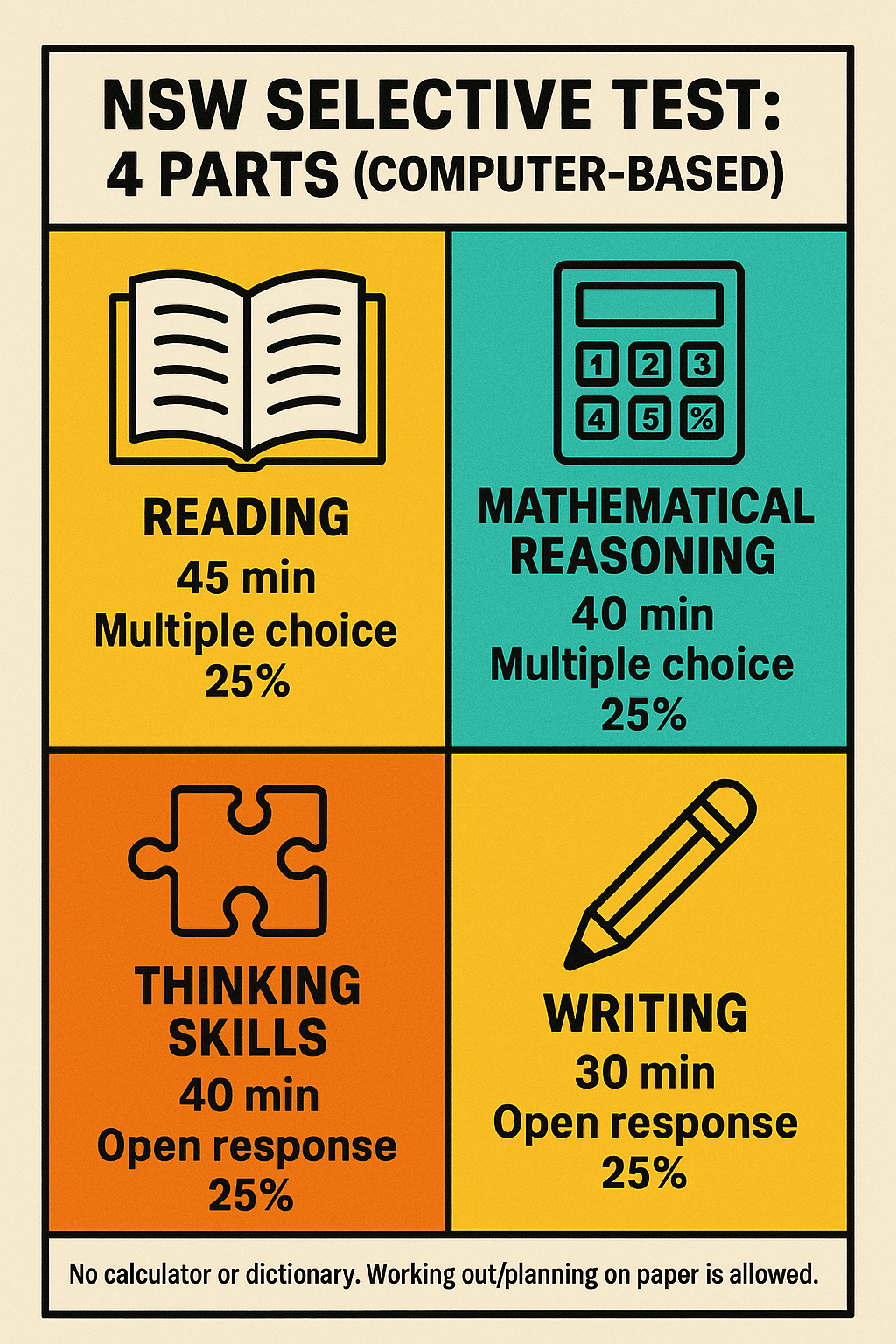
The NSW Department of Education describes the Selective High School Placement Test as a computer-based test with 4 sections, each worth 25%:
- Reading Test: 45 minutes (17 questions; some have multiple parts)
- Mathematical Reasoning Test: 40 minutes (35 questions)
- Thinking Skills Test: 40 minutes (40 questions)
- Writing Test: 30 minutes (1 task)
You cannot use a calculator or dictionary, but you can do working out/planning on paper.
(See References)
What to practise first (highest-return order)
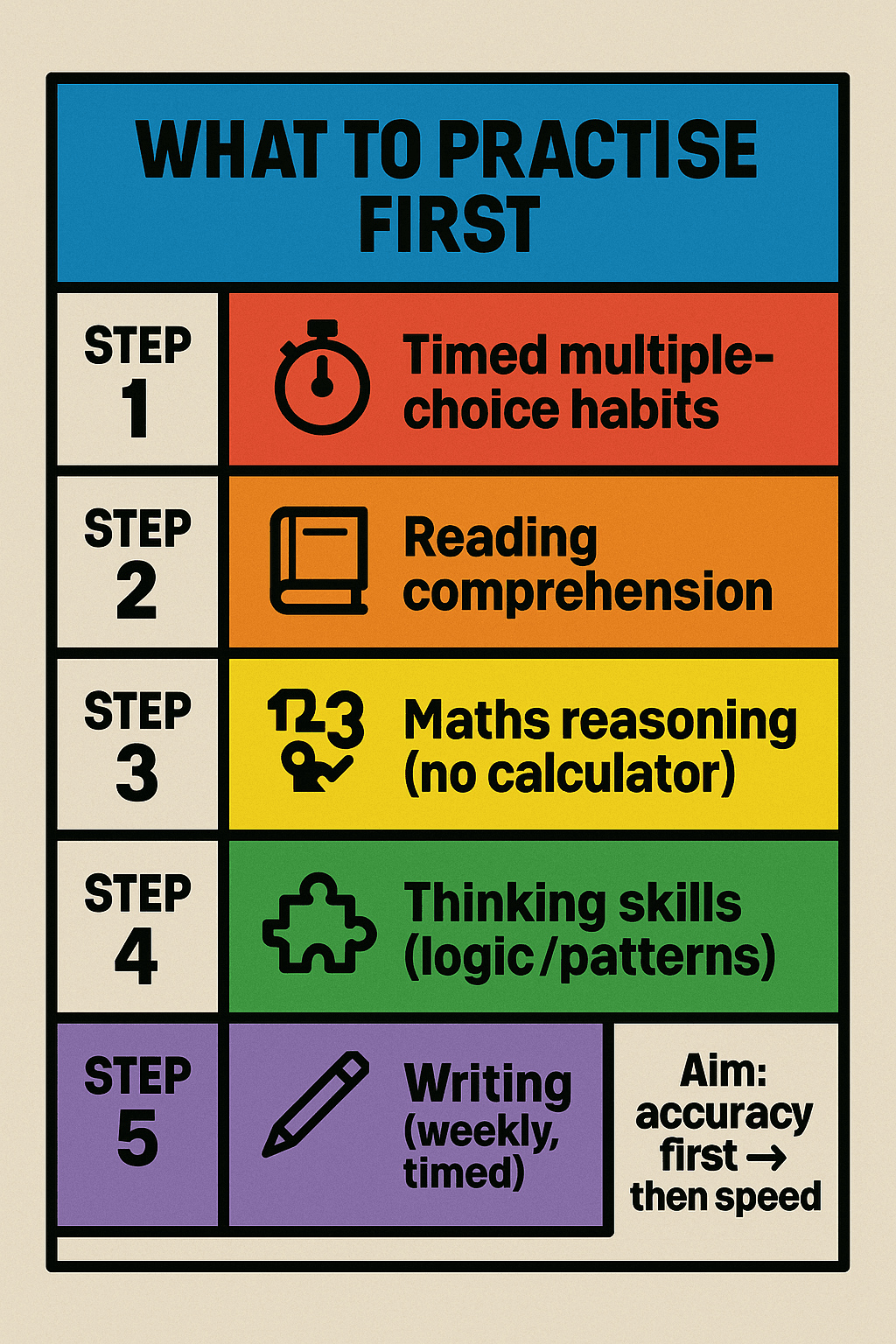
If you’re starting from scratch or short on time, follow this order:
Timed multiple-choice habits (all sections)
Learn to work under a clock: move on, come back, avoid time-sinks.Reading comprehension
Reading speed + accuracy affects both Reading and your ability to interpret wordy problems.Mathematical Reasoning (no calculator)
Build number sense, estimation, and multi-step reasoning.Thinking Skills (logic/patterns)
Learn common question types and practise recognition.Writing (weekly, timed)
Consistency beats intensity: one timed piece per week + feedback.
Section-by-section: what it tests + how to train it
1) Reading (45 minutes)
NSW Education notes the Reading questions use a diverse range of texts (for example: non-fiction, fiction, poetry, magazine articles, reports).
The student guide transcript also notes you’ll provide 38 answers across 17 questions.
(See References)
What to practise
- Finding evidence quickly (“which line proves the answer?”)
- Inference (what is implied, not just stated)
- Comparison questions (two short extracts on the same theme)
Fast practice (15 minutes)
- 1 short passage + 6–10 questions timed
- Review mistakes: write why the right option is right (one sentence)
2) Mathematical Reasoning (35 questions, 40 minutes)
Multiple choice problem solving; no calculator.
(See References)
What to practise
- Estimation and checking options (use answer choices to your advantage)
- Multi-step word problems
- Working layout on paper (clean steps, minimal scribble)
Fast practice (15 minutes)
- 10 mixed questions timed
- Redo any missed question 24–48 hours later (spaced repetition)
3) Thinking Skills (40 questions, 40 minutes)
NSW Education describes this as assessing critical thinking and problem-solving, and says no previous knowledge is required.
(See References)
What to practise
- Pattern recognition
- Rule-based logic (“if/then”, constraints)
- Rapid elimination (why three options are wrong)
Fast practice (10 minutes)
- 8 questions timed
- Track “slow question types” and drill them twice per week
4) Writing (1 task, 30 minutes)
NSW Education describes Writing as assessing:
- creativity of ideas
- ability to write effectively for purpose/audience
- grammar, punctuation, spelling, vocabulary
It also states: if the writing does not address the topic, it will be marked lower.
(See References)
What to practise (simple routine)
- 5 minutes: plan (dot points)
- 20 minutes: write
- 5 minutes: edit (fix clarity + mistakes)
Practical structure
- Intro (answer the prompt clearly)
- 2–3 body paragraphs (one idea each)
- Conclusion (restate + finish strong)
How to use practice tests (so they actually help)
NSW Education provides free practice resources and notes coaching/tutoring isn’t necessary; it also warns that too much coaching can harm wellbeing.
(See References)
Use this loop:
- Timed set
- Mark + categorise mistakes (misread / time / strategy / careless)
- Redo the same questions later
- Only then increase difficulty or time pressure
Test-day basics (quick wins)
- Expect a computer-based sitting in a test centre (often a local high school).
- Use time checkpoints: don’t donate minutes to one hard question.
- For Writing: plan first, stay on the prompt, leave 2–3 minutes to tidy.