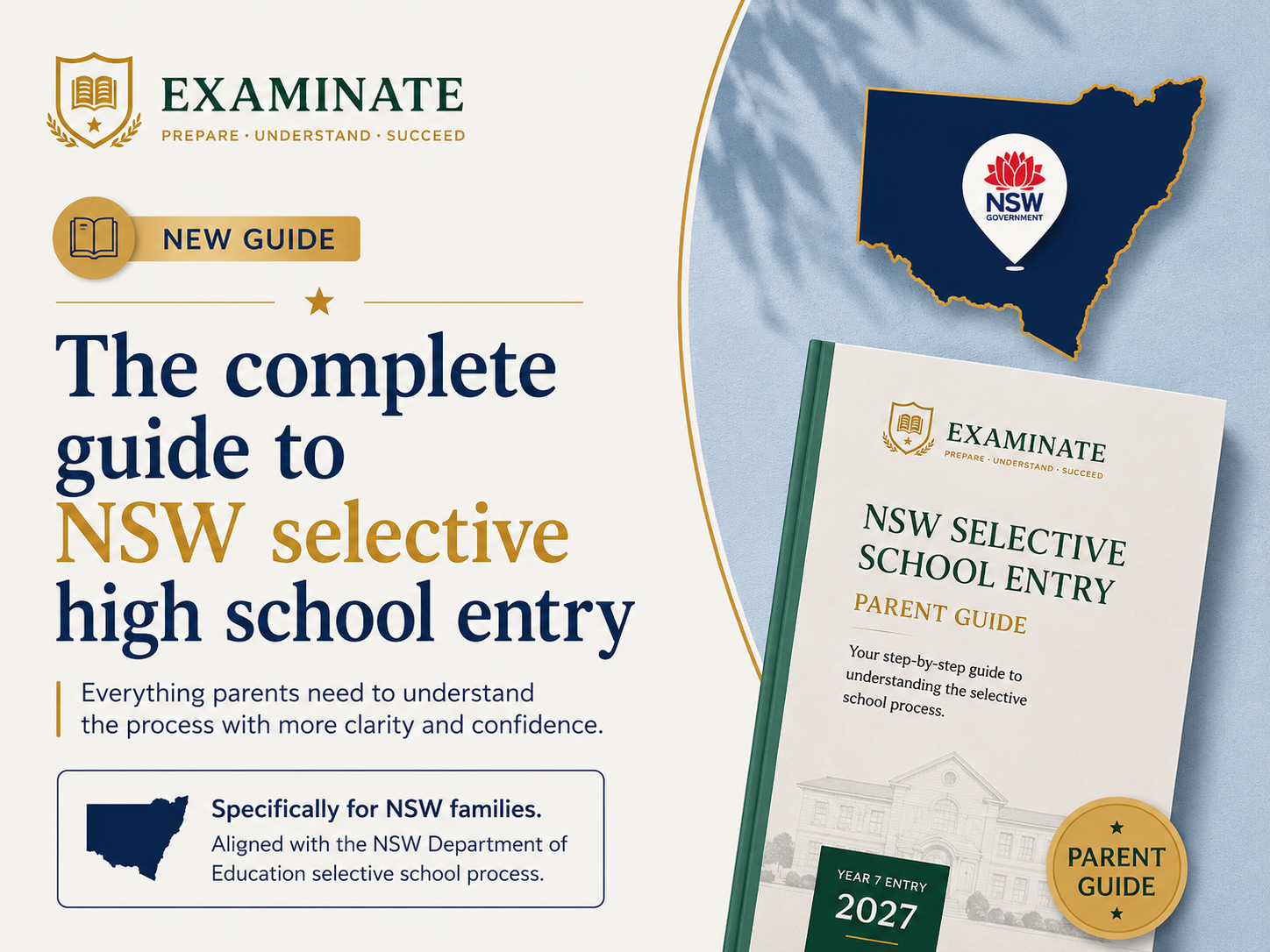
Updated for 2027 Year 7 entry. This guide is updated regularly to reflect the latest NSW Department of Education information and selective test changes.
If your child is in Year 4, Year 5, or early Year 6 and you've started hearing conversations about "the selective test", it can quickly feel overwhelming.
There are application dates to remember, different test sections to understand, changing formats, and endless opinions online about tutoring, rankings, and preparation. Many parents end up feeling like they are already behind before they've even begun.
The good news is that the NSW Selective High School Placement Test becomes much easier to understand once you break it into smaller pieces. And despite how competitive selective entry can seem, preparation does not need to become all-consuming for your child — or your family.
This guide will walk you through:
- what NSW selective schools are
- how the placement process works
- what is included in each test section
- how the test is scored
- realistic preparation timelines
- and how to support your child calmly and effectively at home
What are NSW selective high schools?
NSW selective high schools are government schools designed for high potential and gifted students whose learning needs may be best supported in an academically selective environment.
According to the NSW Department of Education, students are placed through a selective process involving the Selective High School Placement Test and school assessment information. (NSW Department of Education)
Students usually sit the placement test during Year 6 for entry into Year 7 the following year.
Some schools are:
- fully selective
- partially selective
- or specialist agricultural/selective schools
Competition levels vary significantly between schools and locations.
Is selective school the right fit for every child?
This is one of the most important questions parents can ask — and it's often overlooked.
Selective schools can be an excellent fit for children who:
- enjoy academic challenge
- learn quickly
- are naturally curious
- enjoy problem-solving
- and feel motivated in highly academic environments
But no school is automatically the "best" choice for every child.
Things like:
- wellbeing
- friendships
- travel time
- extracurricular interests
- personality
- and learning style
all matter too.
One of the healthiest ways to approach selective entry is not "Can my child get in?" but instead "Would this environment genuinely suit my child?"
That small shift often removes a huge amount of pressure from the process.
How competitive is NSW selective entry?
Selective entry is competitive, particularly for the highest-demand schools.
Each year, thousands of students apply for a limited number of places across NSW selective and partially selective high schools. Placement depends on:
- student performance
- school preferences
- applicant numbers
- and available places
This is important for parents to understand because placement is relative to the performance of the broader applicant group each year.
That means preparation is usually most effective when it focuses on:
- building strong underlying skills
- developing confidence
- and improving targeted weak areas over time
rather than relying on large volumes of rushed practice tests.
NSW selective application timeline (2027 entry)
For students applying for Year 7 selective entry in 2027, the process generally follows this pattern:
| Stage | Typical timing |
|---|---|
| Applications open | Late Year 5 |
| Applications close | Early Year 6 |
| Placement test | May |
| Outcome notifications | Later in Year 6 |
| School entry | Year 7 the following year |
The NSW Department of Education updates dates annually, so parents should always confirm current information through the official website.
Understanding the selective process step by step makes preparation feel much more manageable.
What is actually in the NSW selective test?
The NSW Selective High School Placement Test currently contains four sections:
- Reading
- Mathematical Reasoning
- Thinking Skills
- Writing
According to the NSW Department of Education, the test is designed to assess higher-order thinking and the application of skills under timed conditions. (NSW Department of Education)
Each section assesses slightly different skills, which is why preparation works best when children understand what they are struggling with — not simply how many questions they completed.
| Section | What it really assesses |
|---|---|
| Reading | Interpretation and inference |
| Mathematical Reasoning | Multi-step problem solving |
| Thinking Skills | Logic and pattern recognition |
| Writing | Clarity and idea development |
Selective tests assess how students think under pressure — not just what they memorise.
Reading test explained
The Reading section assesses a student's ability to:
- understand complex texts
- interpret meaning
- identify themes and author intent
- infer information
- analyse language choices
Students may encounter:
- fiction
- non-fiction
- poetry
- persuasive texts
- factual reports
One thing that often surprises families is that selective reading is not simply about being able to read fluently.
A child may read confidently but still struggle if they:
- rush
- miss subtle clues
- misinterpret questions
- or have difficulty managing time pressure
In many cases, strong reading performance comes from careful thinking rather than speed alone.
Mathematical Reasoning explained
Mathematical Reasoning focuses on applying mathematical thinking to unfamiliar problems.
This differs from standard classroom maths because students are often required to:
- interpret multi-step questions
- apply concepts flexibly
- identify patterns
- reason logically
- and solve problems efficiently under time pressure
Strong results usually come from:
- solid foundational maths skills
- careful reading
- and regular exposure to reasoning-based questions
rather than memorising advanced content far beyond year-level expectations.
What "thinking skills" actually means
Thinking Skills is often the section parents feel least familiar with because it does not directly mirror a standard school subject.
According to the NSW Department of Education, this section assesses critical thinking and problem-solving rather than curriculum knowledge. No specific prior content knowledge is required. (NSW Department of Education)
Questions may involve:
- logic
- pattern recognition
- deduction
- sequencing
- relationships between ideas
- analysing information
For many children, Thinking Skills improves gradually through exposure and discussion over time — not through frantic last-minute drilling.
A helpful way to think about it is this: Thinking Skills is less like memorising facts for a quiz, and more like learning how to solve puzzles calmly under pressure.
Writing test explained
In the Writing section, students complete one extended written response within a strict time limit.
The NSW Department of Education states that the task assesses a student's ability to communicate ideas effectively in writing. (NSW Department of Education)
Markers typically assess areas including:
- development of ideas
- structure and organisation
- vocabulary choices
- sentence control
- grammar and punctuation
- writing for audience and purpose
One of the most common misconceptions is that selective writing rewards "big words".
In reality, strong responses are usually:
- clear
- organised
- engaging
- and well-developed
A student with thoughtful ideas and strong structure will often outperform a student forcing sophisticated vocabulary without clarity.
Clear writing feedback helps students understand exactly what stronger writing looks like.
How the NSW selective test is scored
Each section contributes to a student's overall placement calculation.
The Department of Education uses scaling processes to help ensure fairness across different test sessions and applicant groups. Placement decisions may also consider:
- student performance across all sections
- school choices
- equity adjustments
- and placement availability
This is one reason why comparing raw practice test scores between children or tutoring centres is often not especially meaningful.
What usually matters more is:
- identifying patterns
- improving weak areas
- and building consistent performance over time
How early should preparation begin?
Many parents worry they are either starting too late or starting too early.
In reality, the strongest preparation usually develops gradually over time.
Students who cope best with selective-style testing often have years of:
- strong reading habits
- vocabulary exposure
- mathematical confidence
- problem-solving experience
- and resilience with challenging tasks
That does not necessarily mean years of tutoring.
It more often means:
- regular reading
- exposure to rich language
- manageable practice
- and targeted support where needed
What effective selective preparation actually looks like
Many families understandably fall into the trap of thinking: "More tests must mean better preparation."
But practice without understanding can quickly become exhausting and discouraging.
A more effective approach is usually:
- identify specific gaps
- focus on one area at a time
- provide clear feedback
- then revisit similar questions later
For example:
- a child struggling with inference questions needs targeted inference practice — not endless full reading tests
- a child losing writing marks because of weak structure needs help organising ideas — not simply writing more pieces
This is where clear feedback becomes much more valuable than volume alone.
Targeted feedback helps students focus on the skills that make the biggest difference.
How to prepare without burning your child out
This part matters more than many families realise.
Children preparing for selective entry are often only 10 or 11 years old. While preparation can absolutely help, protecting wellbeing matters too.
Some of the most effective preparation habits are actually quite simple:
- short, consistent practice sessions
- regular reading
- enough sleep
- manageable routines
- maintaining hobbies and downtime
- and keeping preparation emotionally calm
Children generally perform much better when they feel supported rather than pressured.
Frequently asked questions
Does my child need tutoring to succeed?
Not necessarily. Some students benefit from structured support, while others prepare successfully at home. Strong foundational skills and targeted feedback are often more important than the amount of tutoring.
How many practice tests should my child do?
Quality matters more than quantity. Practice tests are most useful when they help identify patterns and weak areas.
What is the hardest section for most students?
This varies widely. Many students initially find Thinking Skills unfamiliar because it differs from standard classroom learning.
Can selective schools guarantee academic success?
No school can guarantee outcomes. Selective schools may suit some students very well, but fit, wellbeing, motivation, and support all matter too.
Is it too late to start in Year 6?
Not at all. While earlier preparation can help build confidence gradually, targeted improvement during Year 6 can still make a meaningful difference.
Final thought
Selective entry can feel complicated at first, but preparation becomes much more manageable once you understand what the test is actually assessing.
Your child does not need to master everything immediately. In most cases, the biggest gains come from identifying the right areas to improve, building confidence steadily, and approaching preparation in a calm, consistent way.
And often, that clarity makes the entire process feel much less overwhelming — for both children and parents.
Related reading
You don't need more practice tests. You need to know what to practice.
Doing more practice tests rarely moves the dial. Here's how to spot what your child actually needs to work on — and the small shifts that work better than volume.
NAPLAN writing rubric explained: how NAPLAN writing is really marked
Confused by your child's NAPLAN writing result? Learn how the NAPLAN writing rubric works, what the 10 criteria mean, and how parents can help children improve writing at home.